
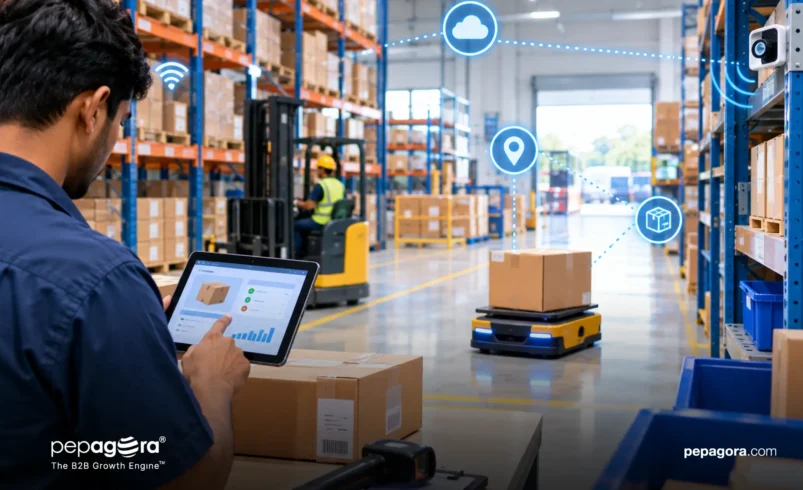

For many MSMEs, warehouse management still depends on spreadsheets, paper records, manual counting and employees knowing where products are stored. These methods may work when operations are small, but they become difficult to manage as inventory volumes and customer orders increase.
Smart warehousing does not necessarily mean expensive robots or fully automated facilities. For smaller businesses, it can begin with affordable digital tools that improve inventory visibility, reduce manual errors and make goods easier to locate and move.
NITI Aayog has identified affordable digital solutions for tracking supply chains, monitoring inventory and managing logistics in real time as an important opportunity for Indian MSMEs.
Start With Digital Inventory Records
One of the simplest steps towards a smarter warehouse is replacing scattered manual records with a centralised digital inventory system.
Basic inventory software can record what has entered the warehouse, what has been dispatched, current stock levels and where products are stored. This gives employees and business owners a more accurate view of inventory without depending on multiple registers or spreadsheets.
The Ministry of MSME also recognises inventory management and supply-chain management as areas that can be supported through digital platforms and software.
Use Barcodes and QR Codes
Barcodes and QR codes are relatively simple technologies that can make inventory movement faster and more accurate.
Instead of manually writing down product details every time an item moves, workers can scan a code when goods are received, shifted, picked or dispatched. This creates a digital movement trail and reduces the possibility of recording errors.
For MSMEs, barcode-based tracking can be introduced gradually, starting with high-volume or high-value products rather than the entire warehouse.
Give Every Product a Defined Location
A warehouse can have sufficient space and still operate inefficiently if employees spend too much time searching for products.
Businesses can create digital or physical location codes for shelves, racks, bins and storage zones. Fast-moving products can be placed closer to dispatch areas, while slower-moving inventory can be stored in less accessible locations.
This simple change can reduce unnecessary movement and improve order-picking speed.
The MSME Lean scheme specifically focuses on reducing product and raw-material movement and improving space utilisation, making warehouse layout an important part of operational efficiency.
Track Stock Movement in Real Time
Knowing how much inventory exists is useful. Knowing where inventory is and how quickly it is moving is even more valuable.
Digital dashboards can help businesses monitor incoming stock, outgoing orders, ageing inventory, fast-moving products and low-stock items. With this information, managers can make purchasing and replenishment decisions based on actual movement rather than assumptions.
NITI Aayog has also highlighted real-time inventory and logistics monitoring, including sensor-based tracking and inventory automation, as potential digital risk-management solutions for MSMEs.
Automate Repetitive Tasks First
MSMEs do not need to automate the entire warehouse at once.
They can begin with repetitive activities that consume significant employee time, such as stock counting, order entry, inventory updates, barcode scanning or generating dispatch records.
Once these processes become digital, businesses can identify where additional automation would provide the greatest return. This gradual approach can make technology adoption more manageable for smaller businesses.
Connect Warehouse Data With Orders
A warehouse becomes more efficient when inventory information is connected with sales and order data.
For example, when an order is confirmed, the warehouse team should immediately know what needs to be picked and where it is located. When the product is dispatched, the inventory record should be updated without requiring multiple manual entries.
NITI Aayog’s advanced manufacturing roadmap highlights digitally connected supply chains and real-time visibility as ways to improve coordination among suppliers, manufacturers and distributors.
Train Employees Alongside Technology
Technology alone cannot create a smart warehouse. Employees need to understand how and when to use the systems correctly.
MSMEs should provide simple training on scanning, stock updates, location systems, digital dashboards and exception handling. Employees should also know what to do when technology fails or inventory records do not match physical stock.
The Ministry of MSME’s Lean programme includes training, handholding and digital empowerment as part of its approach to improving MSME competitiveness.
Conclusion
Smart warehousing is not about transforming a small warehouse into a high-tech facility overnight. It is about using affordable technology to make inventory visible, organised and easier to move.
By starting with digital records, barcode or QR-code tracking, defined storage locations, real-time stock monitoring and targeted automation, MSMEs can reduce errors, save employee time and improve order fulfilment.
The real value of smart warehousing lies not in how advanced the technology looks, but in how effectively it helps businesses know what they have, where it is and when it needs to move.
Frequently Asked Questions
Smart warehousing means using affordable digital tools and technologies to improve inventory visibility, organisation, tracking and movement within a warehouse.
MSMEs can start with digital inventory records, barcode or QR-code tracking, defined storage locations and real-time stock monitoring to reduce errors and improve inventory movement.
No. MSMEs can begin with low-cost technologies such as inventory software, barcode scanning, digital dashboards and targeted automation before investing in more advanced warehouse systems.

About Author
Harsha Varthan
Harsha is a highly respected B2B marketing expert who passionately helps sellers and buyers connect, grow their businesses online, and build strong global visibility. His expertise spans SEO, content marketing, lead generation, marketplace strategy, public relations, and result-driven digital growth planning, making him a trusted voice in the industry.