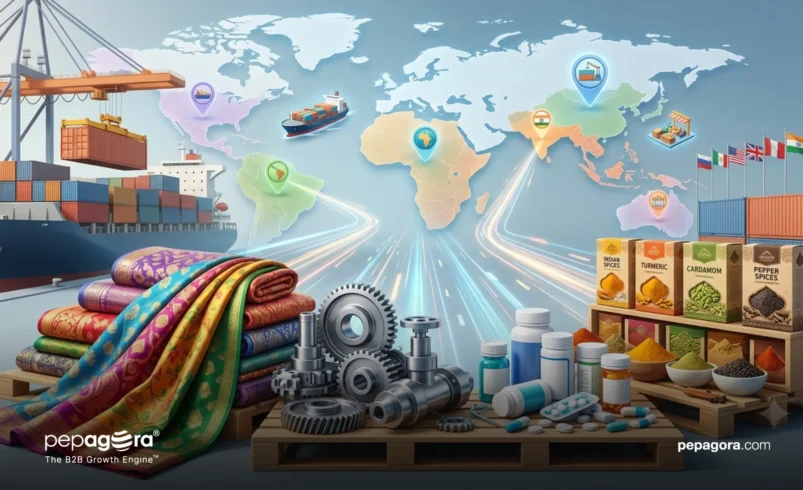

Exporting to one successful region can help an MSME establish itself internationally. But depending heavily on a single market can also expose the business to changes in demand, tariffs, regulations, currency movements, logistics disruptions or geopolitical developments.
For Indian MSMEs, diversifying export markets can create a broader customer base and reduce dependence on one region. This is increasingly relevant as India expands trade relationships and introduces measures aimed at helping smaller businesses access new international markets. The Economic Survey 2025–26 states that MSMEs account for about 48.58% of India’s exports, highlighting their importance to the country’s global trade ecosystem.
Why Export Diversification Matters
A business that receives most of its international revenue from one market may face significant disruption if conditions there change.
Diversification does not mean entering ten countries at once. It means gradually building customers across markets with different demand patterns and risk factors.
For example, an Indian manufacturer selling primarily to one region could explore another market where its product category, quality standards and price positioning are relevant. Over time, this can create a more balanced export portfolio.
1. Identify Markets With Similar Demand
The first step is to look beyond geography and understand where demand for the product already exists.
MSMEs can study:
- Product import trends
- Market size and growth
- Competitor presence
- Buyer preferences
- Applicable tariffs
- Product standards and certifications
- Shipping and logistics costs
India’s official TradeStat system provides country-wise, commodity-wise and region-wise export data that businesses can use when researching potential markets.
2. Explore Markets Supported by Trade Agreements
Free Trade Agreements and other preferential trade arrangements can influence the cost and ease of exporting to a particular market.
India has expanded its network of trade agreements, while the government is also working to improve utilisation of existing agreements and diversify export destinations.
MSMEs should therefore check whether their products qualify for preferential tariffs and understand the relevant rules of origin and documentation before targeting a new market.
3. Do Not Assume Every Market Needs the Same Product
A product that sells well in one country may require adjustments elsewhere.
Packaging, labelling, certifications, product specifications, payment terms and marketing communication can vary between markets.
Before entering a new region, MSMEs should speak with potential buyers, distributors or industry partners to understand these requirements rather than simply exporting the same offering everywhere.
4. Use Digital Channels to Test New Markets
Digital B2B platforms, company websites, online catalogues and cross-border e-commerce can help MSMEs reach buyers without immediately establishing a physical presence overseas.
The goal should be to use digital channels for market testing. A business can identify buyer interest, generate enquiries and understand pricing expectations before committing significant resources to a particular market.
5. Build Multiple Buyer Relationships
Market diversification is not complete if an MSME replaces dependence on one regional buyer with dependence on one large international customer.
Businesses should gradually build a portfolio of buyers, distributors and business partners across different countries.
This spreads commercial risk and can also provide better information about changing demand in different markets.
6. Strengthen Export Readiness
Entering additional markets requires more than finding buyers.
MSMEs need reliable production, consistent quality, appropriate certifications, export documentation, packaging, logistics and payment processes.
The government’s Export Promotion Mission includes support related to trade finance, export quality and compliance, international branding and packaging, market access, logistics and overseas warehousing, with MSMEs among its focus groups.
7. Start With Two or Three New Markets
Diversification should be gradual.
Instead of targeting many countries simultaneously, an MSME can shortlist two or three markets based on product demand, trade access, competition, logistics and regulatory requirements.
The business can then test these markets through trade fairs, distributors, digital platforms, direct buyer outreach and smaller shipments before increasing its investment.
Build a Balanced Export Portfolio
India’s export destinations already span a wide range of markets. In FY 2025–26, major destinations included the UAE, UK, Singapore, Australia, Japan, South Korea, Oman and others, illustrating the breadth of India’s trading relationships.
For an individual MSME, the objective is not simply to follow the largest export markets. It is to identify markets where its specific products have sustainable demand and where the business can build long-term customer relationships.
Conclusion
Export diversification can help Indian MSMEs reduce their dependence on a single region while creating access to new customers and growth opportunities.
The process should begin with market research, product-market fit and trade analysis, followed by small-scale testing and gradual expansion. By building customers across multiple markets, strengthening export capabilities and using India’s growing trade ecosystem, MSMEs can create a more balanced and resilient international business.
Frequently Asked Questions
Indian MSMEs can diversify export markets to reduce dependence on a single region and build a broader customer base across different international markets.
MSMEs can study product import trends, market size and growth, competitor presence, buyer preferences, tariffs, product standards, certifications and shipping costs before entering a new market.
An MSME can start by shortlisting two or three markets based on product demand, trade access, competition, logistics and regulatory requirements, and then gradually expand.