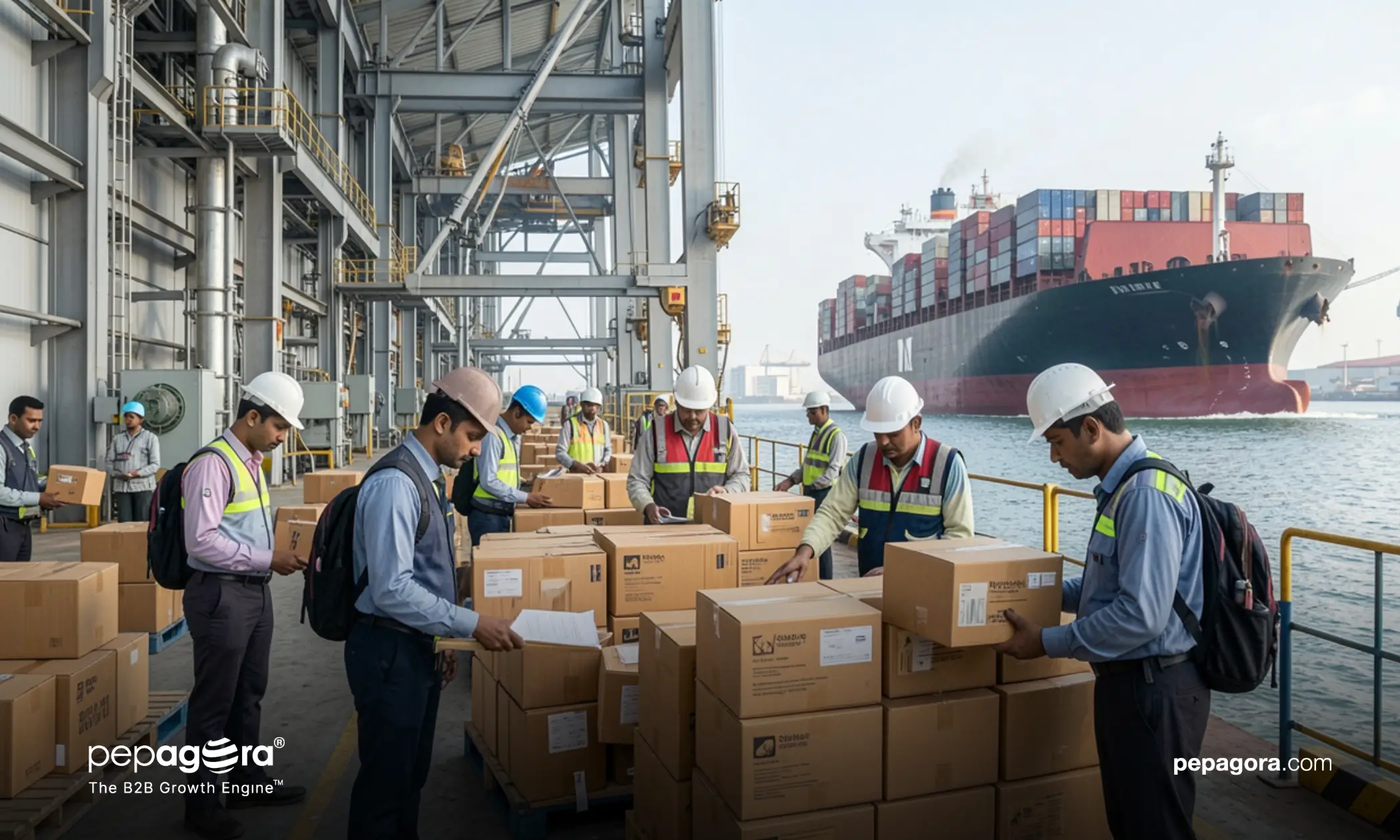


India’s manufacturing, textile, chemical, and engineering sectors are experiencing unprecedented global demand. With robust government trade policies, expanding bilateral trade agreements, and growing international interest in Indian supply chains, there has never been a better time for domestic enterprises to sell to international markets.
However, moving from domestic wholesale transactions to international B2B commerce requires navigating export licenses, customs regulations, international logistics, and global buyer acquisition.
If you are wondering how to export b2b products from India, this comprehensive roadmap walks you through statutory setup, international buyer discovery, compliance documentation, and risk-proof execution.
Step 1: Fulfill Statutory Legal and Taxation Requirements
Before marketing your products to overseas purchasers, you must register your enterprise with Indian regulatory authorities. Missing any of these steps can stall shipments at port customs or delay payment realization.
1. Obtain an Import Export Code (IEC)
Issued by the Directorate General of Foreign Trade (DGFT), the 10-digit Import Export Code (IEC) is mandatory for any commercial shipment leaving Indian borders. You can apply online via the official DGFT portal using your business PAN, bank details, and address proof.
2. File for GST Letter of Undertaking (LUT)
Under GST regulations, B2B exports qualify as zero-rated supplies. To export goods without paying Upfront Integrated GST (IGST) and waiting months for tax refunds, file a Letter of Undertaking (LUT) annually through the GST portal.
3. Register your AD Code on ICEGATE
An Authorised Dealer (AD) Code is a 14-digit identifier issued on official letterhead by your RBI-authorized bank. You must register this AD Code on the ICEGATE (Indian Customs EDI System) portal for every port or airport from which your physical shipments will depart. Without ICEGATE AD registration, Customs cannot generate your Shipping Bill.
4. Join Export Promotion Councils (RCMC)
Depending on your product line (e.g., engineering goods, textiles, agricultural produce), register with the relevant Export Promotion Council (EPC) or the Federation of Indian Export Organisations (FIEO). Obtaining a Registration Cum Membership Certificate (RCMC) grants access to government trade schemes, international trade delegation access, and duty drawback benefits.
Step 2: Classify Products with Correct HS Codes
International trade relies on the Harmonized System (HS) Code—an 8-digit standardized code that determines your export policy, applicable customs duties in destination countries, and compliance rules.
- Free Exports: Most industrial, textile, and manufactured items can be exported freely.
- Restricted or Prohibited Items: Certain dual-use chemicals, specific agricultural commodities, defense items, or endangered biological resources require special licenses from DGFT.
Always double-check the 8-digit ITC (HS) classification to avoid customs rejections or incorrect duty drawbacks.
Step 3: Find Genuine International B2B Buyers
Discovering verified, solvent international buyers is often the hardest hurdle when figuring out how to export b2b products from India. Cold emailing international purchasing agents yields low conversion rates. Instead, leverage modern digital trade channels:
1. Utilize Verified Digital Trade Portals
Listing your factory on a specialized b2b platform for manufacturers like Pepagora accelerates buyer discovery. Digital marketplaces act as 24/7 storefronts that allow international procurement officers, importers, and distributors to view your technical specifications, certifications, and manufacturing capacities.
2. Respond to Active Overseas RFQs
High-value international buyers post immediate sourcing needs via Request for Quotation (RFQ) systems. B2B portals like Pepagora route these incoming RFQ alerts directly to verified Indian manufacturers, enabling you to submit competitive quotes right at the point of buyer purchase intent.
3. Tap Trade Delegations & Indian Embassies
Commercial wings of Indian embassies overseas maintain active lists of accredited importers seeking reliable suppliers in South Asia. Participating in virtual trade meets organized by your Export Promotion Council (EPC) also provides direct access to pre-vetted buyer groups.
Step 4: Prepare Mandatory B2B Export Documentation
Accurate paperwork prevents customs holds, port demurrage fees, and banking disputes. For standard B2B commercial shipments, prepare the following documents:
Document | Purpose | Issuing Authority / Responsible Party |
Commercial Invoice & Packing List | Details shipment value, HS code, unit quantities, weight, and dimensions | Exporter |
Shipping Bill / Bill of Export | Primary document for customs clearance filed on ICEGATE | Custom House Agent (CHA) / Exporter |
Bill of Lading (Sea) / Airway Bill (Air) | Contract of carriage and document of title for goods in transit | Shipping Line / Freight Forwarder |
Certificate of Origin (CoO) | Proves goods were manufactured in India (enables preferential tariff benefits) | Chamber of Commerce / DGFT |
Bank Realisation Certificate (eBRC) | Confirms foreign currency payment received via RBI channels | Exporter’s Bank via DGFT Portal |
Step 5: Secure Export Payments and Mitigate Credit Risk
Extending credit terms (e.g., Net 30 or Net 60) to overseas purchasers can leave your business vulnerable to non-payment. Protect your foreign receivables using structured financial instruments:
- Letter of Credit (LC): Require international buyers to open an Irrevocable Letter of Credit at Sight issued by a top-tier international bank. This guarantees payment upon presentation of compliant shipping documents.
- ECGC Credit Insurance: Obtain export credit insurance from the Export Credit Guarantee Corporation of India (ECGC). ECGC covers losses up to 80-90% if an overseas buyer defaults or faces political/commercial insolvency.
- Advance Telegraphic Transfer (T/T): For initial sample orders or smaller production runs, insist on a 30% advance deposit with the remaining 70% payable against a copy of the Bill of Lading.
Step 6: Dispatch Goods via Freight Forwarders and CHAs
Partnering with experienced logistics professionals ensures smooth physical movement:
- Hire a Licensed Customs House Agent (CHA): Your CHA files the Shipping Bill on ICEGATE, handles physical port inspection, and secures “Let Export Order” (LEO) approval.
- Select Appropriate Incoterms: Agree on standardized Incoterms (e.g., FOB – Free On Board, CIF – Cost Insurance Freight, or DDP – Delivered Duty Paid) in your sales contract to define exact cost and risk responsibilities between buyer and seller.
- Marine Cargo Insurance: Never dispatch international freight without comprehensive transit insurance covering transit damage, pilferage, and general average risks.
Build Your International Export Pipeline with Pepagora
Mastering how to export b2b products from India comes down to combining legal compliance with direct buyer access. By setting up your digital storefront on Pepagora, completing business profile verification, and responding quickly to global RFQ alerts, you can systematically scale your manufacturing operations into profitable international markets.
FAQs: How to Export B2B Products from India
Businesses generally need to complete statutory requirements such as obtaining an Import Export Code (IEC), filing a GST Letter of Undertaking (LUT), registering the AD Code on ICEGATE, and obtaining relevant export registrations.
Businesses can use verified digital trade portals, respond to overseas RFQs, participate in trade delegations, and connect with commercial wings of Indian embassies and Export Promotion Councils.
Common documents include a commercial invoice and packing list, shipping bill, bill of lading or airway bill, certificate of origin, and Bank Realisation Certificate (eBRC).
Exporters can consider payment methods such as an irrevocable Letter of Credit, export credit insurance through ECGC, or advance payment terms depending on the transaction and buyer relationship.
Incoterms such as FOB, CIF, and DDP define the responsibilities, costs, and risks of the buyer and seller during international shipment. They should be clearly agreed upon in the sales contract.