
For decades, fashion sourcing conversations have revolved around three things: price, quality and delivery. Today, there is another conversation slowly becoming just as important data.
If a business manufactures or sells fashion products in Europe, the Digital Product Passport, or DPP, is becoming an increasingly important consideration. At first, DPP may appear to be another compliance exercise for the fashion industry. But its implications are much bigger than that.
At its simplest, a Digital Product Passport is a digital identity for a product. It is intended to make relevant information about a product available throughout its lifecycle. For fashion and textiles, this is expected to involve information around materials, product characteristics, manufacturing and aspects of the product’s lifecycle such as use, repair, reuse and recycling. The detailed requirements for textiles are still being developed, with the European Commission currently planning the textile-specific rules under the Ecodesign for Sustainable Products Regulation for Q4 2027.
So, there is still time. But that does not mean businesses should wait.
Understanding the Digital Product Passport
Working across design, product development, manufacturing and sourcing for more than two decades has shown that the information behind a garment is often much more complicated than it appears.
A brand may know its garment manufacturer. The manufacturer knows the fabric supplier. The fabric supplier has another supplier behind it. By the time a business starts asking where a particular material actually came from, or whether a particular claim can be substantiated, the information can be sitting in several different places.
This is why manufacturers and sourcing companies should pay attention to DPP even if they are not the party legally responsible for placing the product on the European market. The brand may ultimately carry the compliance responsibility, but much of the information required to support that product passport will originate somewhere in the supply chain.
What Information Will DPP Require?
A European buyer may ask a manufacturer about fibre composition, material origin, certifications, manufacturing location or other product information. If the answer is, “Let me check with someone and get back to you,” that may become increasingly difficult to manage as requirements become more structured.
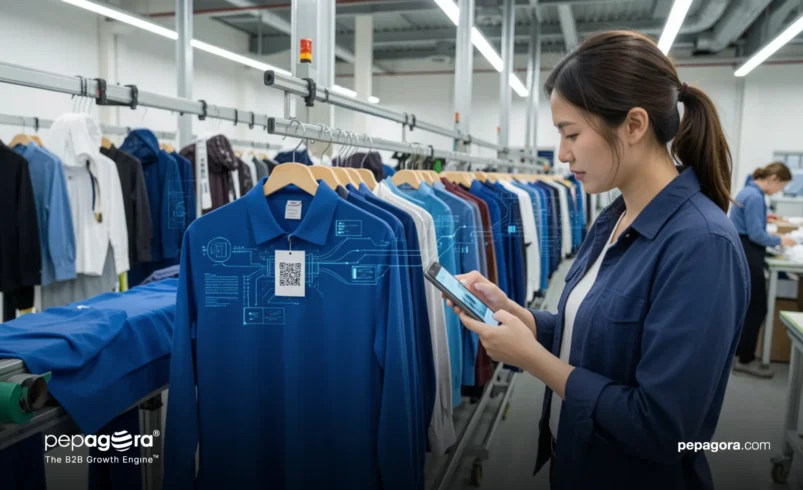
There is also a tendency to think of DPP as simply putting a QR code on a garment. The QR code is the easy part. The real challenge is what sits behind it.
Key questions include:
- Where did the fabric come from?
- What is its actual composition?
- Who supplied it?
- Can the relevant claims be substantiated?
- Where was the garment manufactured?
- What certifications or testing support the information?
- What is known about the product after it leaves the factory?
And perhaps the most important question is: Can the information be proven?
That is why DPP readiness should primarily be viewed as a data-readiness exercise rather than a technology exercise.
How Can Fashion Businesses Prepare for DPP?
Fashion businesses preparing for DPP today do not need to start by looking for the most sophisticated DPP software. A practical approach is to start with one product.
Take a garment that is already being manufactured and simply try to trace the information behind it. Look at the fabric, the fabric supplier, trims, manufacturing location, certifications, testing and product documentation. Then ask how much of that information is readily available and how much needs to be reconstructed.
Many companies may discover that they have most of the information somewhere. The problem is that it may be spread across emails, spreadsheets, supplier documents and different people within the organisation.
Having information and having reliable, structured and traceable information are two very different things.
Why DPP Could Be Positive for Fashion
This is where DPP could actually be positive for the fashion industry.
There is understandably some concern that new regulations mean more work and more paperwork. But better product information can also lead to better businesses.
It can:
- Improve supply-chain visibility
- Reduce repeated requests for information
- Make sustainability claims more credible
- Help brands understand their own products better
- Improve product documentation
- Strengthen supply-chain collaboration
For manufacturers, there is also a potential commercial advantage.
Imagine two suppliers offering similar quality and pricing. One can provide clear and organised product information quickly, while the other has to spend days going back through different suppliers and documents to find it. Over time, the first supplier is likely to become more attractive to international brands.
Can Data Readiness Become a Supplier Advantage?
Data capability could become another part of supplier selection, alongside quality, price, capacity and delivery.
This is particularly relevant for Indian manufacturers and sourcing partners working with international brands. India already has a strong position in the global Apparel & Fashion Industry and textile manufacturing sector.
The next opportunity is not simply to manufacture better or faster, but to become more transparent and more data-ready.
At B&Z Services, the work often sits between product development and manufacturing. This has highlighted how important information is even before a garment reaches the production floor.
Decisions about fabric, construction, suppliers, trims and manufacturing methods all create information that eventually becomes part of the product’s story.
Businesses do not need to completely transform their systems overnight. There is still time to learn, experiment and build the right processes.
However, brands and manufacturers should start asking some basic questions now:
- What information is already available?
- Where are the gaps?
- Which suppliers can provide reliable documentation?
- Can a product be traced back through its supply chain?
- And perhaps most importantly, can the information given to customers be substantiated?
Building a More Transparent Fashion Supply Chain
The bigger change that DPP may bring is cultural.
Fashion has traditionally operated through a fairly fragmented supply chain. Everyone knows the part immediately before them, but visibility becomes weaker as the supply chain moves further upstream.
DPP has the potential to encourage much more collaboration between brands, manufacturers, fabric mills, trim suppliers and other partners.
This can be a positive change for the industry.
After more than 20 years in the industry, experience across the fashion supply chain has shown how often good information gets lost between one stage of the supply chain and another.
If DPP encourages businesses to understand their products better and take greater responsibility for the information behind them, that can only be positive.
The businesses that wait until the regulation becomes mandatory will eventually find a way to comply. But the businesses that start preparing now have an opportunity to do something more valuable: build a supply chain that is more organised, transparent and trusted.
Why DPP Readiness Matters
The real opportunity behind the Digital Product Passport is not simply about a QR code. It isn’t simply another compliance document.
It is about knowing a product well enough to tell its story—and having the information to prove that the story is true.
FAQs About Digital Product Passports in Fashion
A Digital Product Passport is a digital identity for a product that is intended to make relevant information about the product available throughout its lifecycle. For fashion and textiles, this can include information about materials, product characteristics, manufacturing, use, repair, reuse and recycling.
DPP readiness depends on having reliable, structured and traceable product information. Information about materials, suppliers, manufacturing, certifications and testing may come from different parts of the supply chain.
Manufacturers can start with one product and trace the information behind it. This includes reviewing the fabric, fabric supplier, trims, manufacturing location, certifications, testing and product documentation.
Yes. Suppliers that can provide clear and organised product information quickly may become more attractive to international brands. Data capability could become another supplier-selection factor alongside quality, price, capacity and delivery.
Although detailed textile-specific requirements are still being developed, businesses can use the available time to identify information gaps, improve documentation and build reliable, structured and traceable supply-chain processes.