
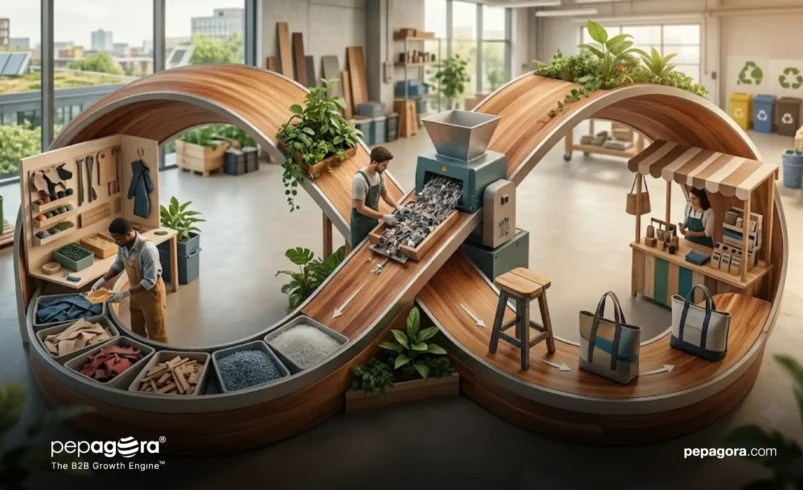

For many businesses, waste is treated as an unavoidable operating cost. But in a circular economy, discarded materials can become inputs for another product, process or business. This shift is becoming increasingly relevant for Indian MSMEs. The government has introduced multiple initiatives supporting circular economy practices, including the MSE-SPICE scheme, which helps eligible micro and small enterprises invest in circular solutions. The scheme covers areas such as plastic, rubber, e-waste, scrap metal, batteries, solar panels and used oil.
For MSMEs, the opportunity is to look at waste not simply as something to dispose of, but as a resource with potential economic value.
What Is the Circular Economy?
A traditional business model often follows a simple pattern: take resources, make products and dispose of waste.
A circular economy aims to keep materials and products in use for longer through strategies such as reducing, reusing, repairing, refurbishing, remanufacturing and recycling.
For an MSME, this could mean recovering production scrap, selling recyclable by-products, using recycled inputs or creating new products from materials that would otherwise be discarded.
The result can be lower material costs, additional revenue and better resource efficiency.
Identify Valuable Waste Streams
The first step is to understand what a business is throwing away.
Manufacturers may generate metal scrap, plastic waste, textile offcuts, packaging materials, rejected components, chemicals or other by-products. Service businesses may generate paper, electronic equipment, packaging and other recyclable materials.
Instead of looking at all waste together, businesses should categorise it by type, volume, frequency and potential reuse value.
A simple waste audit can reveal which materials are being purchased repeatedly but then partially discarded.
Turn Production Scrap Into Revenue
Production waste can sometimes become a secondary source of income.
For example, metal, plastic, rubber or textile waste can be segregated and sold to recyclers or other businesses that use those materials as inputs.
Businesses can also explore whether certain production by-products can be processed and reused internally, reducing the need to purchase new raw materials.
The objective is to move from waste disposal to material recovery.
Explore Circular Products and Services
Circularity can also create entirely new business models.
An MSME could offer repair services, refurbishment, remanufacturing, product take-back programmes or recycled-material products.
For example, a manufacturer could collect used products from customers, recover valuable components and use them in refurbished products.
This creates an additional relationship with the customer while extending the useful life of materials.
Build Partnerships With Other Businesses
An MSME does not have to create its own recycling facility to participate in the circular economy.
Partnerships can connect businesses that generate waste with those that can use it. Verified B2B connections can help businesses discover potential suppliers, buyers and business partners.
A textile manufacturer, for example, could work with another enterprise that converts fabric waste into recycled fibre, accessories or other products.
Industrial clusters can make such connections easier by bringing multiple businesses and shared infrastructure together.
Use Better Waste Segregation
Waste has little value when different materials are mixed together.
India’s Solid Waste Management Rules, 2026, which came into effect from April 1, 2026, introduced mandatory four-stream segregation at source and strengthened the integration of circular economy and Extended Producer Responsibility principles.
For MSMEs, better segregation can improve the quality and recoverability of materials while also supporting compliance with applicable waste-management requirements.
Use Government Support
MSMEs exploring circular business models can also examine available government support.
The MSE-SPICE scheme provides a capital subsidy for eligible plant and machinery investments by micro and small enterprises adopting circular economy solutions. The government has also identified circular economy, green technology and resource efficiency as areas of support under MSME programmes.
Businesses should check current eligibility and scheme guidelines before making investment decisions.
Measure the Business Value
Circularity should not be treated only as a sustainability initiative.
MSMEs should measure practical business outcomes such as:
- Reduction in raw-material costs
- Revenue from recovered materials
- Reduction in waste-disposal costs
- Percentage of materials reused or recycled
- Energy and resource savings
- Revenue from refurbished or recycled products
These measurements can show whether a circular initiative is actually improving business performance.
From Waste Management to Waste-to-Value
The most important mindset shift is to stop viewing waste as the final stage of production.
One business’s waste can potentially become another business’s raw material. India’s circular economy framework already recognises recycling and reuse as opportunities for resource recovery, formalisation and economic activity across multiple waste categories.
For MSMEs, this opens opportunities not only to reduce environmental impact but also to create new products, services, partnerships and revenue streams.
Conclusion
The circular economy can give MSMEs a practical way to combine sustainability with business growth. By identifying valuable waste, improving segregation, recovering materials, developing circular products and partnering with other businesses, companies can turn part of their waste stream into an economic opportunity.
The businesses that start treating materials as valuable resources rather than disposable inputs can build more efficient operations while discovering new sources of revenue in the process.
Frequently Asked Questions
A circular economy helps MSMEs keep materials and products in use for longer through practices such as reuse, repair, refurbishment, remanufacturing and recycling.
MSMEs can segregate and sell recyclable materials, reuse production scrap, develop recycled-material products, offer refurbishment services or create partnerships with businesses that can use their waste.
Circular practices can help MSMEs reduce raw-material and waste-disposal costs, improve resource efficiency, create new products and services, and develop additional revenue opportunities.
