
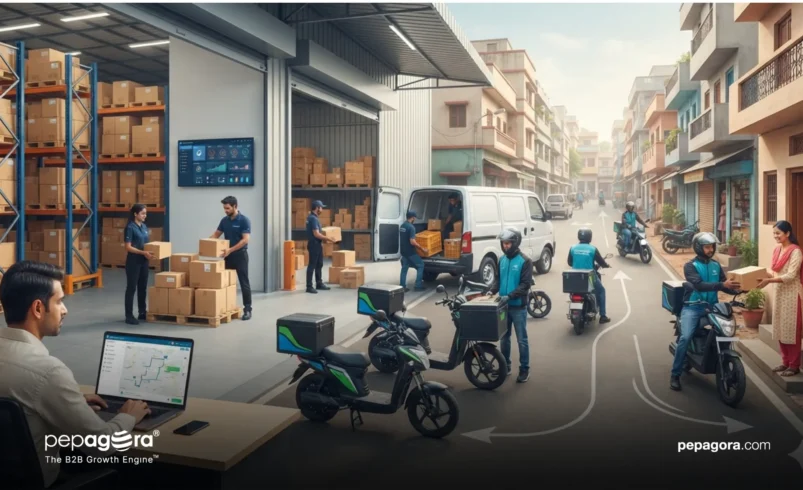

In case of MSMEs, successful delivery of orders is equally important as getting the customer. Late or lost shipments, non-delivery, high costs of transport can rapidly impact the customer’s satisfaction levels and profits.
The last mile is one of the most difficult steps to take care of as it is the very last stage after the local distribution facility and before the end consumer. It is also the part of the supply chain which customer experiences.
With Indian companies serving more customers across cities, towns and small markets, the delivery system needs to have resilience against any disruptions.
1. Avoiding the Risk of Reliance on One Logistics Partner
Dependence on just one courier or logistics company poses the risk of various problems. Should a logistics partner face such challenges like capacity restrictions, service breakdowns, problems along specific routes or delays in a certain area, then the business will not have any other option but wait.
MSMEs can avoid such risk by having partnerships with more than one logistics firm. Partnerships with different logistics firms can vary depending on different factors including region, size, speed and type of the shipment.
2. Using Technology to Gain Visibility
Visibility is an essential feature of a robust delivery network. Use of logistics technology can assist businesses in tracking shipments, identifying delays, assessing delivery performance and informing the customers about the situation.
Route optimisation and operational data are also useful. The use of logistics technology by even smaller businesses can start with shipment tracking.
3. Optimize Inventory and Delivery Planning
Problems associated with last mile deliveries often start long before the deliveries take place. Having inventory stored far away from the customers or products going out of stock often means that delivery costs and time are going to rise.
MSMEs need to examine from where the orders are received, find ways to place fast-selling products closer to high concentrations of customers.
4. Plan for Regional Issues
The delivery process in India varies greatly from one area to another. The state of roads, addresses, availability of delivery agents, weather, and infrastructure may influence the last mile of the delivery process. Therefore, companies which are going to expand to Tier-2, Tier-3 and rural markets cannot use the same approach across the board.
5. Create Effective Communication Systems
Customers are more accepting of a delay if they are informed of it. MSMEs must ensure that their customers are informed in good time of confirmation, dispatch, delivery, delay, and delivery success. Effective communication could also help prevent failed deliveries resulting from customer unavailability and inaccurate delivery information. Effective communication could prove useful in preventing avoidable returns among businesses that accept cash-on-delivery orders.
6. Measure Delivery Performance
Resilience increases when businesses measure the areas that are doing poorly. There are several factors that MSMEs must consider and measure on a regular basis, namely:
- Percentage of orders delivered on time
- Percentage of failed deliveries
- Percentage of orders returned to origin
- Average time for delivering
- Percentage of orders lost/damaged
- Cost of delivering per order
- Customer complaints
These factors could help businesses pinpoint problem areas.
7. Prepare Alternative Plans in Case of Disturbances
For a flexible network, contingency planning must be done even before the disruption happens. Firms can plan for alternate suppliers, alternate paths to deliver goods, alternate fulfillment centers, and emergency communication methods. For vital or urgent cargo, firms can also think about alternative modes of transport.
In logistics programs of the government, multimodal connectivity, digital logistics system, and efficient first and last mile infrastructure have become priorities lately for increasing supply chain flexibility.
8. Consider Reliability When Comparing Logistics Partners
The most economical delivery method does not necessarily mean being cost-effective.
If the lowest cost of shipment leads to recurring delays, delivery failures, damages, and customer dissatisfaction, then it becomes an expensive affair for the firm. Logistics partners can be considered by MSMEs in terms of their performance as well.
Conclusion
The establishment of robust last-mile delivery systems for MSMEs is achieved not through reliance but by means of being flexible.
With the use of multiple logistics providers, enhanced shipment visibility, smart inventory planning, knowledge of the local issues, customer communication, and contingency planning, it will be possible for the MSMEs to have dependable delivery processes.
The issue of logistics will become more and more a source of competitive edge as businesses venture into new markets.
FAQs About Last-Mile Delivery Networks for MSMEs
Last-mile delivery is the final stage of the supply chain, where products move from a local distribution facility to the end customer.
MSMEs can work with multiple logistics providers based on region, shipment type, delivery speed, and service reliability.
Logistics technology helps MSMEs track shipments, identify delays, monitor delivery performance, and keep customers informed.
MSMEs should measure on-time delivery rates, failed deliveries, returned orders, delivery time, damaged shipments, delivery costs, and customer complaints.
MSMEs can prepare alternative delivery routes, logistics partners, fulfilment centres, suppliers, transport modes, and customer communication methods.