
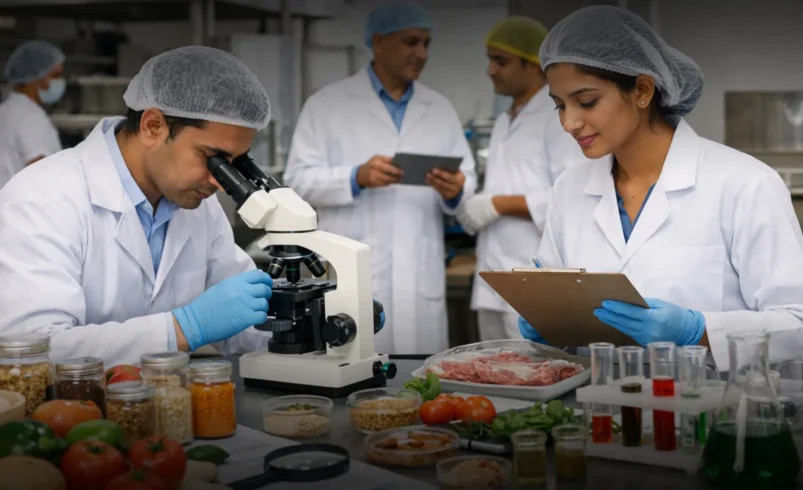

As global food supply chains become more complex, the demand for reliable food testing services and quality control services has moved from optional to essential. Whether it is domestic retail, horeca supply, or international exports, food safety and compliance now define business credibility.
For B2B stakeholders, including manufacturers, exporters, and distributors, food lab testing is no longer just about regulatory approval. It is about trust, consistency, and long-term market access.
Industry Overview and Market Size
The global food testing and inspection market is expanding rapidly due to stricter safety standards and rising consumer awareness.
Key industry stats:
The global food testing market is valued at over USD 25 billion
Expected growth rate is 7–8% CAGR over the next decade
Over 70% of food exporters rely on third-party testing services
Increasing demand for bulk food testing services from large-scale manufacturers
India is also witnessing growth in this sector, driven by export demand and regulatory requirements.
What Are Food Testing and Quality Control Services
Food testing services involve analyzing food products to ensure they meet safety, quality, and regulatory standards.
These services include:
Microbiological testing
Chemical analysis
Pesticide residue testing
Heavy metal testing
Shelf-life testing
On the other hand, quality control services focus on maintaining consistency across production, packaging, and distribution.
Businesses often work with food testing and quality control services suppliers to ensure end-to-end compliance.
Role of Food Lab Testing in B2B Supply Chains
In B2B trade, food lab testing acts as a validation mechanism between buyers and suppliers.
Why It Matters:
Ensures compliance with domestic and international regulations
Builds trust with buyers and partners
Reduces risk of product recalls
Improves product consistency
Large buyers often prefer working with high-quality food testing supplier or certified labs before finalizing procurement.
Types of Food Testing Services
Microbiological Testing
Identifies harmful bacteria such as:
Salmonella
E. coli
Listeria
This is critical for food safety compliance.
Chemical and Nutritional Testing
Evaluates:
Nutrient content
Additives and preservatives
Chemical contaminants
Pesticide and Residue Testing
Essential for agricultural and export products.
Allergen Testing
Ensures labeling accuracy and consumer safety.
Shelf-Life Testing
Determines product stability over time.
Businesses offering these services are often listed as food lab testing manufacturers, food lab testing suppliers, and food lab testing exporters.
Bulk Testing and Inspection Services
With the rise of large-scale food production, demand for bulk food testing services is increasing.
Who Needs Bulk Testing:
Food processing companies
Exporters and importers
Retail chains
HoReCa suppliers
These businesses rely on:
Bulk food testing services supplier
Bulk food inspection services wholesaler
Bulk testing helps in maintaining uniform quality across large product batches.
Key Buyers of Testing and Quality Control Services
Demand for food testing services comes from multiple sectors.
Major buyers include:
Food manufacturers and processors
Exporters and importers
Retail chains and supermarkets
Government agencies
Certification bodies
These buyers often engage with food testing and quality control services wholesalers for large-scale requirements.
Export-Driven Demand for Food Testing
Export markets have strict compliance requirements, making testing services essential.
Key Requirements:
Adherence to international standards
Certification from approved laboratories
Traceability and documentation
Businesses exporting food products rely on:
Food testing and quality control services exporters
Premium food lab exporter
Without proper testing, products may face rejection in international markets.
Growth of Organic and Specialized Testing
The rise of organic and clean-label products has created demand for specialized testing services.
Key Trends:
Testing for organic certification
Non-GMO verification
Chemical-free product validation
Buyers often search for organic food testing services supplier to meet these requirements.
Industry Trends Driving Demand
Stricter Food Safety Regulations — Governments worldwide are tightening food safety norms.
Rising Consumer Awareness — Consumers are more conscious about food quality and safety.
Growth in Food Exports — Export growth is directly increasing demand for testing services.
Expansion of Processed Food Industry — Processed and packaged food categories require continuous testing.
Digital Integration in Testing — Technology is improving testing accuracy and reporting speed.
Challenges in the Industry
Despite growth, the sector faces certain challenges.
High Testing Costs — Testing services can be expensive for small businesses.
Infrastructure Gaps — Not all regions have access to advanced testing labs.
Regulatory Complexity — Different markets have different compliance requirements.
Turnaround Time — Delays in testing can impact supply chain timelines.
Growth Strategies for Businesses
Companies offering food testing services can scale by adopting the right strategies.
Expand Service Portfolio — Offer comprehensive testing solutions under one roof.
Invest in Advanced Technology — Automation and AI can improve accuracy and efficiency.
Strengthen Certifications — Being a certified quality control services manufacturer builds trust with clients.
Target Export-Oriented Clients — Focus on businesses involved in international trade.
Build Strong B2B Networks — Partnering with manufacturers and exporters can drive consistent demand.
Future Outlook
The future of food testing services and quality control services looks highly promising.
Key growth drivers include:
Increasing global food trade
Stricter compliance requirements
Rising demand for organic and premium products
Expansion of food processing industry
India is expected to become a major hub for food lab testing and inspection services in the coming years.
In today’s competitive and regulated food industry, food testing services are no longer optional. They are a critical component of business operations, ensuring safety, quality, and compliance.
From manufacturers to exporters, every stakeholder in the supply chain depends on reliable quality control services to maintain standards and build trust.
Businesses that invest in robust testing systems and partner with the right service providers will be better positioned to scale, enter global markets, and sustain long-term growth.