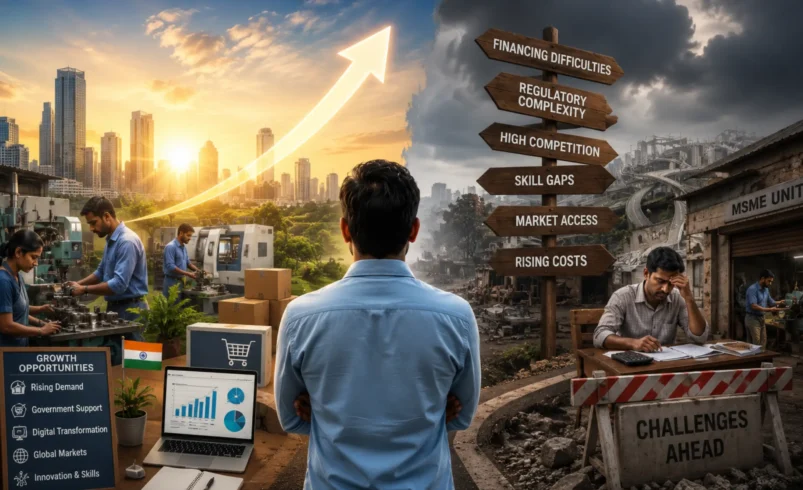

India’s economic growth story continues to gather momentum, creating new opportunities for businesses across sectors. At the center of this transformation lies the Micro, Small, and Medium Enterprise (MSME) sector, often described as the backbone of the Indian economy. From manufacturing and exports to services and innovation, MSMEs play a critical role in generating employment, supporting industrial production, and contributing to national economic development.
As India moves toward becoming one of the world’s largest economies, MSMEs are uniquely positioned to benefit from emerging opportunities. However, they must also navigate a rapidly changing business environment marked by increasing competition, technological disruption, evolving customer expectations, and global economic uncertainties.
MSMEs Continue to Drive India’s Economy
India’s MSME sector remains one of the country’s most important economic pillars. According to government estimates, India has more than 63 million MSMEs, contributing approximately 30% of the country’s GDP and nearly 45% of total exports. The sector also employs over 110 million people, making it one of the largest sources of employment after agriculture.
From small manufacturing units and engineering workshops to exporters, service providers, traders, and technology firms, MSMEs are deeply integrated into India’s economic ecosystem. As the economy expands, their importance is expected to grow even further.
Manufacturing Growth Creates New Opportunities
India’s push to strengthen domestic manufacturing is creating favorable conditions for MSMEs. Government initiatives aimed at increasing industrial production, improving infrastructure, and attracting investments are generating demand across multiple sectors.
Industries expected to benefit include:
- Engineering goods
- Auto components
- Chemicals
- Pharmaceuticals
- Textiles
- Electronics
- Industrial machinery
- Construction materials
Many larger manufacturers increasingly rely on MSMEs as suppliers and production partners, creating opportunities to participate in domestic and global supply chains.
Export Potential Is Expanding
Global supply chain diversification is opening new doors for Indian businesses. International buyers are increasingly seeking alternative sourcing destinations, and India has emerged as a preferred option due to its manufacturing capabilities, skilled workforce, and competitive costs.
Markets showing strong potential for Indian exporters include the Middle East, Africa, Southeast Asia, Europe, and North America. Improved trade agreements, better logistics infrastructure, and digital sourcing platforms are making it easier for MSMEs to access overseas markets. Businesses that invest in export readiness and international quality standards may find significant growth opportunities in the coming years.
Digital Transformation Levels the Playing Field
Technology is helping smaller businesses compete with larger organizations. Digital tools are enabling MSMEs to reach customers nationwide, access international buyers, manage inventory efficiently, improve customer service, and automate business processes to minimize operational costs.
Digital adoption is particularly important as buyers increasingly prefer online supplier discovery and digital procurement processes. Businesses that embrace technology are likely to improve both efficiency and market reach.
Tier-2 and Tier-3 Cities Are Emerging as Growth Centers
Economic growth is no longer limited to major metropolitan regions. Cities such as Indore, Coimbatore, Surat, Jaipur, Rajkot, Lucknow, and Bhubaneswar are becoming important business hubs due to:
- Lower operating costs
- Improving regional infrastructure
- Skilled workforce availability
- Growing local consumer demand
- Better digital connectivity
Many MSMEs located in these cities are successfully serving both domestic and international markets. This geographic diversification is creating fresh pockets of opportunity across the country.
Rising Domestic Consumption Supports Business Growth
India’s growing middle class continues to drive demand across multiple sectors. Increasing disposable incomes are boosting consumption of consumer goods, healthcare items, electronics, home improvement products, processed foods, and personal care items. This expanding domestic market provides a stable growth foundation for MSMEs while they explore international opportunities.
Access to Technology Is Improving
Artificial Intelligence, cloud computing, automation, and data analytics are becoming more affordable and accessible. Today, even smaller businesses can leverage technology for demand forecasting, customer engagement, financial management, inventory optimization, and marketing automation. Businesses that adopt these tools early may gain competitive advantages through increased productivity and improved decision-making.
Key Challenges Facing the Sector
The Challenge of Access to Finance
Despite significant opportunities, access to capital remains one of the biggest challenges facing MSMEs. Many businesses continue to struggle with working capital shortages, limited collateral, high borrowing costs, and delayed loan approvals.
Although government programs and financial institutions have expanded support mechanisms, financing remains a critical concern for many entrepreneurs. Without adequate capital, businesses may find it difficult to invest in expansion, technology upgrades, or export development.
Delayed Payments Continue to Impact Growth
Late payments remain a persistent issue across the MSME sector. Many businesses experience payment cycles extending closures beyond 60, 90, or even 120 days.
The consequences include:
- Severe cash flow pressures
- Reduced operational flexibility
- Delayed internal investments
- Increased borrowing requirements and debt accumulation
Industry bodies continue to advocate for faster payment practices and broader adoption of digital payment systems to address this challenge.
Increasing Competition Requires Differentiation
Digital commerce has increased market access, but it has also intensified competition. Businesses now compete not only with local suppliers but also with companies from across India and international markets.
To remain competitive, MSMEs must focus on:
- Product quality and compliance
- Customer service and support
- Continuous innovation
- Brand credibility and trust
- Faster response times
- Targeted digital visibility
Differentiation is becoming increasingly important in crowded markets.
Technology Adoption Remains Uneven
While many MSMEs are embracing digital transformation, others continue to rely on traditional business practices. Common barriers include limited technical expertise, budget constraints, resistance to change, and a lack of awareness. Businesses that delay technology adoption may face challenges competing against more agile and digitally enabled competitors.
Compliance Requirements Are Growing
Regulatory and compliance requirements are becoming increasingly complex. Businesses must navigate evolving tax regulations, export documentation, quality certifications, and environmental standards. While these standards often improve business credibility, they can also create administrative burdens for smaller enterprises.
Global Market Volatility Creates Uncertainty
International trade offers tremendous opportunities, but it also exposes businesses to external risks. MSMEs must manage challenges such as currency fluctuations, geopolitical developments, freight cost volatility, and supply chain disruptions. Building resilient business models is becoming increasingly important in a rapidly changing global environment.
The Road Ahead for Indian MSMEs
The outlook for India’s MSME sector remains highly promising. Economic growth, infrastructure development, manufacturing expansion, digital transformation, and growing export opportunities are creating favorable conditions for long-term success.
However, businesses must remain adaptable and proactive. Those that invest in technology, strengthen financial management, improve digital visibility, explore export markets, and focus on building trust with customers are likely to be best positioned for future growth.
India’s expanding economy presents a historic opportunity for MSMEs. The businesses that successfully balance opportunity with preparedness today may emerge as the next generation of industry leaders.