
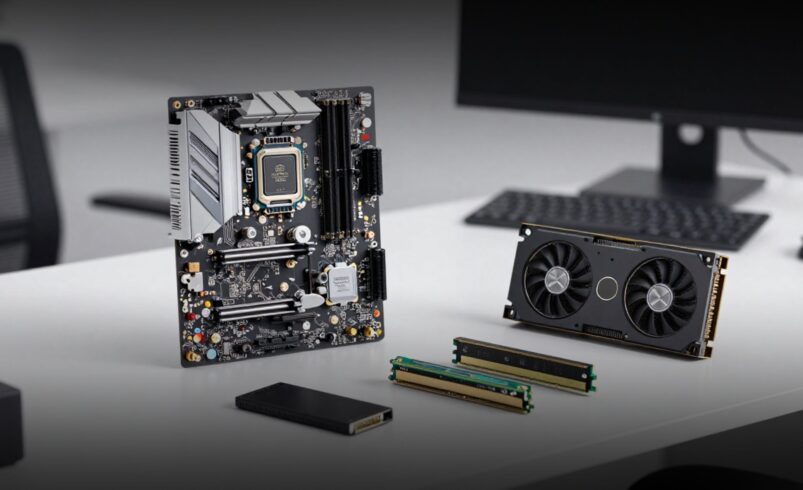

From Basic Systems to High Performance Computing
Earlier business operations relied on standard desktops and basic servers for routine tasks. However, the growing complexity of industrial applications has driven demand for specialized and high performance computer hardware systems.
Today, organizations are investing in advanced workstations, GPU powered machines, and enterprise grade servers designed for intensive applications such as 3D modeling, simulation, and big data processing. These systems deliver faster processing speeds, improved graphics capabilities, and higher efficiency.
High performance computing allows businesses to reduce downtime, improve accuracy, and accelerate project timelines, making it a key investment area in modern industries.
The Shift Toward AI Driven and 3D Integrated Systems
The B2B ecosystem is currently seeing a major shift toward high performance, specialized hardware that seamlessly integrates with advanced 3D and AI driven software. Businesses are no longer just looking for generic tools. There is a rising demand for workstations and rendering systems that can handle complex digital twins and rapid prototyping.
This transformation is especially impactful in sectors like engineering, automotive, and industrial design, where precision and speed are critical. By combining powerful hardware with intelligent software, companies can simulate real world conditions, test product designs, and optimize performance before production begins.
According to National Institute of Standards and Technology, advanced manufacturing systems that integrate computing and digital technologies significantly improve production efficiency and innovation outcomes.
Cloud Collaboration and Smart Manufacturing Growth
Looking ahead, the market is expected to focus heavily on cloud based collaboration tools that allow global teams to design and iterate in real time. Connected hardware systems enable seamless communication between teams, regardless of location.
This trend is a key component of Smart Manufacturing, where integrated systems improve efficiency, reduce production time, and enhance overall workflow management. Hardware is no longer isolated but part of a connected ecosystem that supports real time data exchange and automation.
Businesses that adopt these technologies gain a competitive advantage through faster decision making and improved scalability.
The Importance of Scalable and Integrated Hardware Solutions
Modern enterprises are moving away from standalone devices and toward fully integrated hardware ecosystems. These systems combine computing power, storage, networking, and software compatibility into a single streamlined solution.
Scalability has become a major factor in procurement decisions. Companies prefer hardware that can grow with their operations and adapt to changing technological requirements.
Reliable hardware infrastructure ensures business continuity, minimizes system failures, and supports long term growth strategies.
Common Computer Hardware and Business Usage 2026
Hardware Type | Key Function | Industry Usage (%) |
Workstations | High performance computing | 74 |
Servers | Data storage and processing | 81 |
GPUs | AI and graphics processing | 69 |
Networking Devices | Connectivity and communication | 77 |
Cloud Systems | Remote access and collaboration | 66 |
Efficient Procurement Strategies for Computer Hardware
Selecting the right computer hardware requires evaluating performance, compatibility, and scalability based on business needs.
An effective approach includes comparing vendors, reviewing specifications, and focusing on long term value rather than just cost. Digital procurement tools help streamline this process by centralizing supplier and product information. Solutions such as Pepagora enable access to verified suppliers and structured hardware options.
Assessing supplier reliability and support ensures consistent performance and reduces operational risks. A strategic procurement approach supports scalability and long term growth.
The Future of Business Computing Infrastructure
Computer hardware will continue to evolve as industries adopt advanced technologies and digital workflows. Integration with AI, cloud computing, and automation will further enhance business capabilities.
Organizations that invest in high quality, scalable, and integrated hardware solutions will be better positioned to handle future challenges and opportunities.
As demand for smart, connected systems grows, computer hardware will remain a key factor in driving industrial innovation and business success.
FAQs
It supports data processing, automation, and digital operations, improving efficiency and productivity.
Manufacturing, engineering, IT services, healthcare, and design industries.
Performance, scalability, compatibility, and supplier reliability
It enables real time collaboration and scalable computing resources.
Platforms like Pepagora connect buyers with verified hardware suppliers.

He helps brands transform ideas into manufacturable products by combining functional design with practical production insights. Through Pepagora, he shares knowledge on product development, design accuracy, and efficient prototyping.