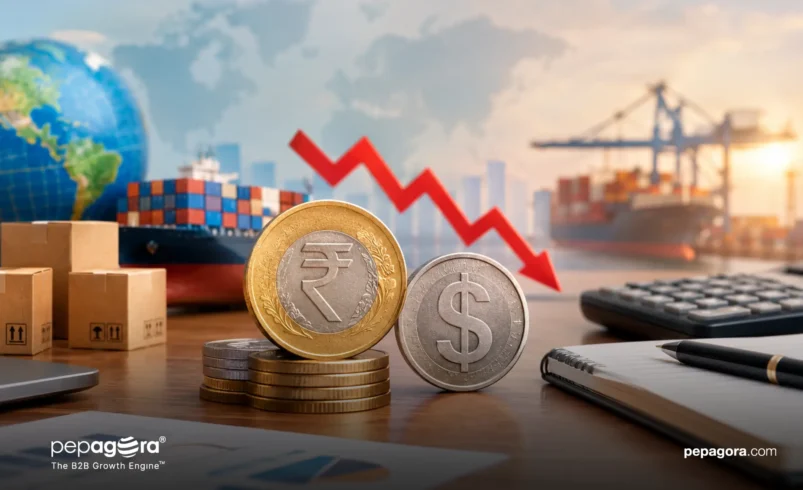

The Indian rupee’s depreciation can create both opportunities and challenges for small and medium enterprises. For an export-oriented business, a weaker rupee can make Indian products more competitive in overseas markets. For an importer dependent on foreign machinery, raw materials or components, however, the same movement can increase costs and squeeze margins.
For SMEs, the key is not simply to predict where the rupee is headed. Currency markets are difficult to forecast consistently. The better approach is to manage exposure, protect margins and build greater flexibility into pricing, sourcing and financing decisions.
This becomes particularly important as Indian MSMEs play a major role in international trade. Government data shows that products associated with MSMEs accounted for 48.55% of India’s merchandise exports in 2024-25.
Why Rupee Depreciation Matters to SMEs
Consider an Indian manufacturer importing components from overseas.
If a component costs US$100, its rupee cost will rise when the rupee weakens against the dollar, assuming the dollar price remains unchanged.
The impact can appear in several places:
∙Imported raw materials become more expensive.
∙Machinery and equipment purchased from abroad cost more.
∙Foreign software and technology subscriptions become costlier.
∙Existing dollar-denominated loans can become more expensive in rupee terms.
∙Freight and other international expenses may rise.
∙Profit margins can decline if selling prices cannot be increased immediately.
Exporters can experience the opposite effect. If an Indian exporter receives US dollars and converts them into rupees, a weaker rupee can increase the rupee value of those receipts.
But exporters should not assume that depreciation automatically means higher profits. Imported inputs, foreign currency expenses, competition, buyer negotiations and hedging arrangements can all influence the final margin.
1. Start by Measuring Your Currency Exposure
The first step for an SME is to understand how much of its business is actually exposed to foreign exchange movements.
Create a simple monthly currency exposure statement covering:
Foreign currency receivables
Money expected from overseas customers.
Foreign currency payables
Payments due to overseas suppliers.
Imported inputs
Raw materials, components and other inputs whose prices are linked to foreign currencies.
Foreign currency loans
Any borrowing or financial obligation denominated in another currency.
Foreign currency operating expenses
Software, services, licences, freight or other recurring expenses.
The business can then calculate its net exposure.
For example:
Expected dollar receipts: $500,000
Expected dollar payments: $350,000
Net exposure: $150,000
This gives management a much clearer picture than simply saying that the company is “affected by the dollar.”
2. Do Not Try to Predict the Rupee
The most important principle in currency management is to avoid building a business strategy around a prediction about the next exchange-rate movement.
Instead, SMEs should focus on understanding their exposure and deciding how much risk they are comfortable carrying.
An exporter expecting dollar receipts may benefit from rupee depreciation, while an importer may face higher costs. Businesses with both imports and exports should evaluate the combined effect rather than looking at each transaction separately.
Currency management should therefore focus on protecting business margins rather than attempting to consistently predict currency markets.
9. Use Government Export Support Where Applicable
Indian SMEs should also examine available export-support programmes instead of treating currency pressure in isolation.
The government’s Export Promotion Mission, with an outlay of ₹25,060 crore for FY 2025-26 to FY 2030-31, includes measures covering trade finance, export factoring, credit support, compliance, logistics and market access.
For eligible MSME exporters, the Niryat Protsahan component includes support mechanisms such as interest subvention on certain export credit, export factoring and credit-related assistance.
These programmes do not eliminate currency risk, but they can help reduce other financial and operational pressures associated with exporting.
SMEs should check the latest eligibility conditions and operational guidelines before relying on any particular benefit.
Businesses can also consider common export challenges when evaluating the wider financial and operational risks associated with international trade.
10. Expand into Multiple Export Markets
Currency risk can also become more manageable when a company is not excessively dependent on one overseas market.
An SME selling exclusively to one country may face several risks simultaneously:
∙Currency volatility
∙Local economic slowdown
∙Buyer concentration
∙Regulatory changes
∙Logistics disruption
Expanding into multiple markets can diversify the company’s revenue base.
India’s export ecosystem is also becoming more accessible to smaller businesses. Recent policy changes have sought to facilitate MSME participation in cross-border e-commerce and reduce barriers for small-value exporters.
For an SME, this creates an opportunity to gradually test international markets rather than making a large investment in one market at the outset.
SMEs can also explore strategies for reaching global buyers when expanding into new international markets.
11. Maintain a Currency Risk Dashboard
A simple internal dashboard can help management make faster decisions.
Track these indicators every week:
Indicator | What to Monitor |
USD/INR | Current exchange rate |
Foreign receivables | Amount and due date |
Foreign payables | Amount and due date |
Net exposure | Receivables minus payables |
Hedged exposure | Percentage already protected |
Imported content | Share of product cost |
Export pricing | Current price vs margin |
Cash position | Foreign and domestic currency |
Major contracts | Currency and payment terms |
This converts currency risk from a finance department issue into a management-level business metric.
A Practical Approach for Indian SMEs
There is no single solution that works for every SME.
An export-heavy manufacturer may focus on hedging, overseas market expansion and contract pricing.
An import-dependent manufacturer may focus more on supplier diversification, domestic sourcing and inventory planning.
A company with both imports and exports may benefit from matching foreign currency receipts and payments.
The common principle is to avoid leaving significant currency exposure unmanaged.
The 5-Step Currency Protection Framework
- Measure
Know exactly how much foreign currency exposure the business has. - Match
Where possible, align foreign currency receipts with foreign currency payments. - Hedge
Discuss appropriate hedging instruments with an authorised bank when exposure justifies it. - Price
Build currency movement into quotations and contracts where commercially possible. - Diversify
Reduce dependence on one supplier, one market or one foreign currency.
The Bigger Opportunity
Rupee depreciation is not necessarily bad news for every Indian SME.
For exporters with substantial domestic value addition, a weaker rupee can improve price competitiveness in international markets. But the advantage is strongest when the business has controlled its imported input costs, protected its margins and built a diversified customer base.
The businesses that benefit most are unlikely to be those that simply wait for the currency to move in their favour.
They will be the businesses that measure their exposure, manage their costs, protect their margins and use global markets strategically.
For Indian SMEs, currency management should therefore become part of everyday business planning rather than an emergency response whenever the rupee weakens.
Frequently Asked Questions
Rupee depreciation can increase the cost of imported raw materials, machinery, software, loans and other foreign-currency expenses, while exporters may receive higher rupee value from foreign-currency earnings.
Indian SMEs can manage currency risk by measuring their foreign-currency exposure, matching receipts with payments, using appropriate hedging strategies, adjusting pricing and diversifying suppliers and export markets.
Yes. A weaker rupee can make Indian products more price-competitive in international markets and increase the rupee value of foreign-currency receipts. However, the benefit depends on imported input costs, competition, pricing and hedging arrangements.