
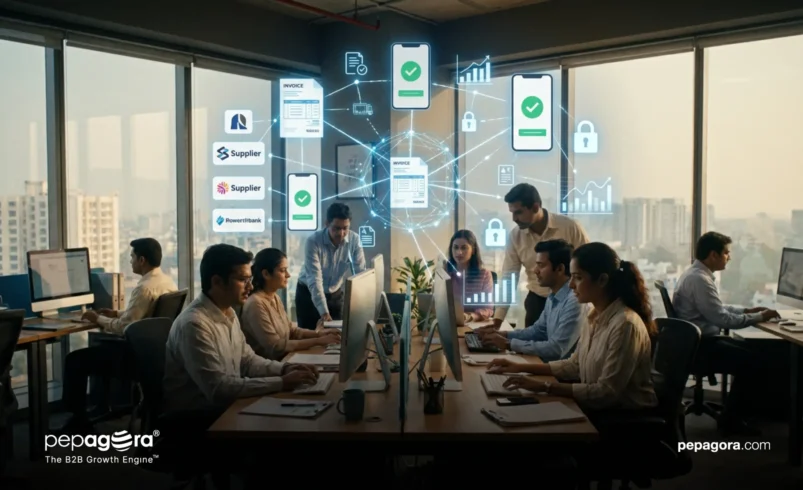

The digital payments landscape in India is currently functioning at an extremely large scale. As per the data from NPCI, more than 24.5 billion transactions were processed through UPI in August 2026.
The next stage in this might be that of making these transactions smart. Rather than individuals looking for products themselves, comparing different options and then initiating payments, AI agents can initiate some actions within the process as per pre-decided instructions and budgets.
This new concept is termed Agentic Payments.
What Are Agentic Payments?
The traditional form of digital payments involves having someone start the transaction process. In cases where the process is quick, the individual usually chooses the merchant, checks on the total sum and authorizes the payment.
Agentic payments add an AI component to the transaction process. For instance, an AI agent would be able to interpret what the company needs, select the appropriate vendor, verify prices and initiate the payment process.
In other words, the AI agent can take charge of the process and seek human intervention whenever the transaction exceeds a certain limit. For example, the MSME can program the AI system to buy supplies for the office below a specific budget limit.
It is different from simply using AI chatbots for answering payment queries.
India Already Has the Building Blocks
India does not start at square one. The country has UPI that gives it a very advanced infrastructure for digital payments, and NPCI has already been tinkering with AI in the payments domain.
UPI Help was launched by NPCI as an AI-powered chatbot for handling questions related to payments and UPI mandates. Additionally, FiMI has been launched in February 2026 by NPCI as a payment-focused AI model tailored for India’s financial environment.
The RBI too has acknowledged the capabilities of conversational payments. It has talked about a business model wherein the user interacts with the AI-powered system to perform UPI transactions.
These facts do not indicate that autonomous payments have become standard practice. Instead, they are indicative of how AI and digital payment systems are converging.
What Could Agentic Payments Mean for Businesses?
- Quick Routine Purchases
AI agents could manage routine purchasing processes like buying of stock and supplies.
A firm could develop criteria concerning suppliers, budget, quantities and approval thresholds that would make it possible for routine purchases to be done in an efficient way without any extra efforts.
- Effective Cash Flow Management
The AI agent could have the ability to manage invoices, due dates and recurring expenses and determine those payments that require action.
This would help firms with many suppliers and customers to minimize the efforts needed in the management of everyday transactions.
3. More Customisable Business Transactions
The AI agents can be trained with specific business parameters for transactions. The firm could give more weightage to price, time to deliver, previous records or even the payment terms of suppliers while assessing the transaction.
4. MSMEs Have Better Chances in Agentic Commerce
The model of agentic commerce could revolutionize the way consumers assess their suppliers and discover the suppliers.
As AI agents find products based on technical specifications, price, availability and details of the suppliers, an MSME having accurate information about their products, pricing, inventory and business could become more assessable to the automated buyer system.
Security and Control Will Be Essential
While the main concern is not only whether AI has the capability of making payments, but also when it should be permitted to do so.
In any money transaction, there should always be proper verification and controls of risks and frauds. The RBI has been constantly insisting on the importance of authentication and security in digital payments as well as trying other forms of authentication.
In this case, the agency payment systems will require some control like:
- Transaction/spending limits
- Only pre-authorized suppliers
- Manual authorization for large sums of money
- Proper authentication
- Fraud/anomaly detection
- Duly maintained transaction details
- Procedures of reversal or dispute of transactions
The idea should be not giving financial autonomy to the AI, but rather giving it limited autonomy.
How MSMEs Can Prepare
MSMEs need not rush into implementing autonomous payment systems. Instead, they should start with improving the underlying digital infrastructure needed for these systems.
They should ensure the availability of proper information about suppliers and products, digitization of payments and invoices, cybersecurity and proper approval procedures.
MSMEs may also try using AI for tasks like invoices structuring, payment reminders, procurement research and financial reporting.
Conclusion
In India, agentic payments can lead to a shift from manual payments to smart payments in business transactions driven by rules.
India’s UPI platform and increasing adoption of artificial intelligence in payments lay a strong foundation for such a shift.
For the MSME sector, the value in agentic payments does not lie in automation alone but in building up the necessary data security and operations infrastructure in order to enable AI to perform routine transactions under human control.
FAQs About Agentic Payments in India
Agentic payments are AI-assisted transactions where an AI agent can perform payment-related tasks based on predefined instructions, budgets, supplier criteria, and approval limits, while seeking human intervention when required.
Agentic payments could help businesses manage routine purchases, recurring expenses, invoices, and supplier payments based on predefined rules. This may reduce manual effort in everyday financial transactions.
Agentic payments are still an emerging concept. However, India's UPI infrastructure and developments in AI-powered payment systems provide building blocks for more automated and intelligent payment processes.
MSMEs can prepare by digitizing invoices and payments, maintaining accurate supplier and product information, strengthening cybersecurity, and establishing clear approval procedures and spending limits.
Businesses should consider transaction limits, pre-authorized suppliers, manual approval for high-value transactions, authentication, fraud detection, transaction records, and procedures for payment reversal or disputes.
