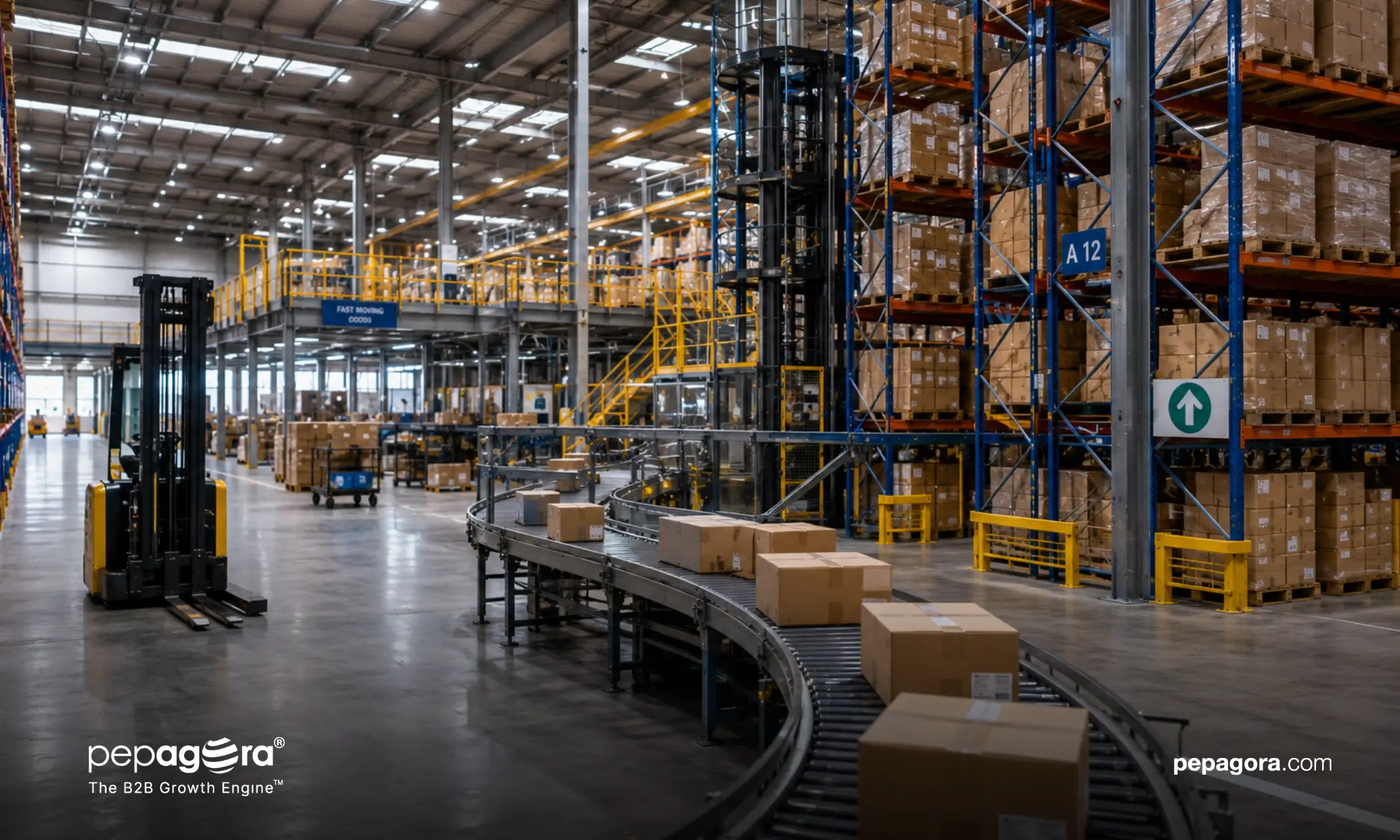
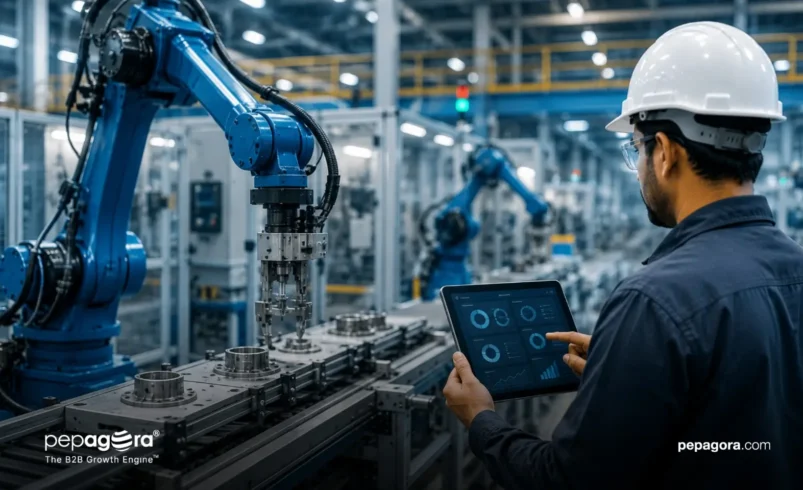

Walk into any trade show on industrial automation, and you will be greeted by six-axis robots whizzing by at breakneck speed, AI-laden dashboards, and autonomous guided vehicles. For an Indian MSME factory owner struggling with lean margins, volatile raw material prices, and exacting production schedules, this can be intimidating. Many manufacturers, when walking away from these exhibitions, develop a fear that automation means buying a robot, throwing away their legacy machines, and completely rebuilding their factory floor – a costly and time-consuming proposition. Automation Equipment & Robotics can be part of this broader manufacturing ecosystem, but automation does not always require a complete factory transformation. Hence they do nothing.
The first step in your industrial automation journey should not be to buy a robot. It should be to identify the right problem on your shop floor to solve with automation.
Industrial automation is not about replacing your factory with brand new equipment; it is about enhancing it, a step at a time.
If you are new to the concept and need guidance on where to start, this framework is for you.
Why Indian MSMEs Are Afraid of Automation
Before jumping into how to automate, it is important that we acknowledge why MSME manufacturers are hesitant about automation in the first place.
This fear usually comes from a rational desire to minimize risk, and not from an anti-technical upgrade sentiment.
When dealing with MSME-level machining, plastics, or assembly plants, capital expenditure is a wellguarded and heavily rationed surplus.
The fear is that automation is a deep-pocket exclusive, meant for tier-1 suppliers only.
You look at your shop floor, comprised of traditional lathes, mechanical presses, or manual assembly jigs, and believe that you need to replace your entire production floor to achieve any form of automation.
You worry that you do not have the technical or financial capacity to integrate new machines into your current setup.
You ask yourself if it is worth it – if automation can truly offset your costs and deliver a tangible ROI, or are you going to waste capital on unneeded “flashy robotics”?
These fears have real grounding, but they stem from a faulty premise, one where automation is seen as either a binary, all-or-nothing proposition.
Let’s change that.
Robots Aren’t the Answer. What Is?
The best way to start automating is to not start with a robot.
You have to visit your shop floor and identify what processes can be automated.
Any factory or plant has several interconnected processes, such as material handling, machine loading/unloading, machining/forming, visual inspection, sorting, assembly, packing, and dispatch.
Each one has to be looked at closely to identify if and where automation can be applied.
Not every process needs an industrial robot.
Often, a visual inspection camera can do the job of an entire robot cell.
A basic pneumatic pusher and a PLC can significantly reduce “dead time” on your manufacturing cell.
The important thing is to match the process to the technology.
To do that, we need a system.
Here’s how to get started with a 10-step framework to factory automation.
Step 1: Identify Repetitive Processes
What makes a process fit for automation?
Often it is a simple matter of repetition and predictability.
Humans are very intelligent and resourceful, but they are also prone to error, especially in a monotonous and repetitive task.
Anywhere a human operator is asked to perform the same movement over and over, like in manual press feeding, machine tending, or even box packing, it qualifies as a candidate for automation.
A good starting point is to identify processes which are manual and repetitive. NIST: Robotics and Automation in Manufacturing.
Look for processes with a high degree of manual handling, poor working conditions, and high cycle time.
Are your workers manually feeding metal blanks into a hot forging press?
Do you have employees working in poorly ventilated and hazardous conditions to move parts from one conveyor to another?
These are also prime candidates for automation.
High repetition, high predictability, and high inconvenience to humans are three factors which indicate a viable candidate for automation.
Step 2: Measure Cycle Time
If you are going to automate, you need to identify what to automate.
This means that you must first measure.
Before you call any vendor or system integrator, you need to understand the fundamentals of your current process.
It is important to measure the cycle time of your process, be it machining, forming, conveying, etc.
How many units are you able to turn out per shift?
What is your theoretical max?
How much time does a human operator take between changeovers?
How much time is lost due to a break or a material handoff?
Automating a process means making it faster and more reliable.
It is important to identify the right metric to measure improvement.
If a manual operator takes 15 seconds to load your CNC machine, while the machining cycle takes 4 minutes, it would be a waste of time and capital to automate the former.
The machining process is your true constraint, and it would make more sense to automate it and reduce that 4 minutes to 1.5 minutes.
This would provide a much greater throughput boost than trying to automate your CNC loading/unloading.
This is why it is critical to measure process cycle time and determine the true constraint in your manufacturing cell or process.
Step 3: Find the Quality Bottleneck
There are some processes which are not repetitive, but are still good candidates for automation.
These are processes where human error causes frequent quality issues.
Any process which involves visual inspection (surface finish, presence/absence of a feature, dimensional verification) is a prime candidate for the application of machine vision systems.
Manual inspection at any point in your process, especially high-speed conveyor-based inspection, is a frequent cause of production pile-ups and quality rejections.
This can happen when an operator looks at hundreds of identical machined parts going by on a conveyor belt and tries to spot a few with surface scratches or missing threads.
By the end of his shift, his eyesight will have deteriorated severely, leading to frequent false rejections and failures to catch actual defects.
These are the ideal candidates for machine vision systems, which can operate flawlessly 24/7 and provide far greater inspection flexibility than the human eye.
Step 4: Calculate the Real Cost of Your Manual Process
A common argument made by Indian MSME manufacturers is that automation makes no sense when labor is abundant and cheap.
I have heard too many factory owners moan that they would rather spend ₹15,000/month on two operators than ₹15 Lakhs on an automation system.
This is true when you look only at labor costs.
Where these factory owners fail is in calculating the true cost of their manual process.
When calculating your ROI for automation, always remember that you must value the cost of a human error.
If a faulty product from your manual process is causing you ₹1,000 worth of losses (downstream rework, rejected consignments, etc.), and you are spending only ₹500/month on your operators, it makes much more sense to automate that process.
The true cost of a manual process is the cost of errors, expressed in terms of material loss, rework, labor, downtime, and opportunity cost (value of the product if it had been made perfectly).
Step 5: Start Small
Do not attempt to automate your entire production line at once.
Pick one process, automate it, and measure results.
Your first automation system does not need to be a massive one that converts your entire plant into a futuristic dark factory.
It can start by automating one particular process or step, such as CNC machine tending or visual inspection.
Starting small has many advantages.
It reduces your capital expenditure and implementation risk, has minimal impact on your overall production rate, and provides positive proof of concept.
This will allow your plant and people to “get used to the idea” of automation, and will ease you into the next steps.
The most important step in this phase is to pick one process that will be genuinely useful to you, and to not overestimate your automation needs at this stage.
Step 6: Add Sensors and Data
To sense, to measure, to inspect, to count, to know.
These adjectives are all synonyms for a simple automation concept – the addition of sensors to existing or new machines.
Sensors can provide you with a wealth of data about your machines, such as pressure, temperature, position, speed, and more.
This information is critical to optimizing your process, and can help you identify quality or production-related issues.
Do not always think of sensors as fancy or expensive devices.
Sometimes something as simple as a proximity sensor can provide you with vital information, such as how many parts are passing by on a conveyor belt.
Other times, you may need to install encoders on a conveyor motor to precisely measure how fast it is moving.
Sensors give you information and flexibility, making your factory smart.
Step 7: Add Machine Vision
When it comes to visual inspection, alignment, and measurement, machine vision systems are the holy grail of factory automation.
The beauty of a machine vision system is that it is simple to understand, while providing incredible flexibility and scope for automation.
The architecture of a machine vision system is intuitive – a camera sees the world, the image is processed by software that understands the world, and then an output is sent that makes the machine world react to the physical world.
In simpler terms, a machine vision system sees the world, knows what it sees, and can perform an action based on that information.
Machine vision systems can inspect almost anything, from machined components to printed circuit boards to assembly line products.
They can also provide a wealth of information, such as how many products have passed by, or whether an assembly is complete or not.
They are extremely useful in a wide variety of processes, from quality inspection to guidance, alignment, and more.
A good rule of thumb when choosing a machine vision system is to always understand that while conventional rule-based systems are great at measuring and evaluating simple things, modern computer vision and AI algorithms offer much greater flexibility.
A frequently asked but erroneous question is, “How much does a machine vision system cost?”
The real question should be, “How much value can a machine vision system bring to my process?”
Like all aspects of automation, you must think in terms of value when it comes to machine vision systems.
You will be surprised at how little the cost really is when you consider the value.
Step 8: Add Robotics Where Needed
After adding sensors and machine vision systems to your process, you are now ready to add in robots.
Robotic systems are typically added to automate physical processes, such as physical manipulation or placement of objects.
These systems are not useful everywhere, but when added to processes requiring high repeatability, they can provide incredible value.
If your manufacturing process has a clearly defined repetitive physical task, such as pick and place, machine tending, arc welding, palletizing, or applying a sealant layer, it is a good candidate for robotic automation.
The wrong question to ask is, “Where can I apply a robot in my factory?”
The right question to ask is, “Where can a robot add value to my process?”
Step 9: Calculate ROI
It is now time to put your automation system on paper and calculate its ROI.
Your factory owner or plant manager needs hard figures to justify capital expenditure, and this is where you come in.
Let’s try an example.
Here, we will calculate the ROI of an automated cell that will perform CNC machining.
In this process, three operators are required to run the cell over three shifts, while automated CNC machining will reduce cycle time and reduce errors.
Manual Process
Labor (3 Operators): ₹5.4 Lakhs/Year
Rejection Cost: ₹4 Lakhs/Year
Parts Produced: 1,000/day
Automated Process
Capital Cost (Bot + Gripper): ₹18 Lakhs
Operating Cost: ₹1 Lakh/Year
Reduced Rejection Cost: ₹3.8 Lakhs/Year
Labour (1 Supervisor): ₹2.5 Lakhs/Year
Throughput Improvement: ₹3 Lakhs/Year
Using this rough calculation, you can see that while the labor costs of the automated cell are reduced, the true value of automation is seen in reduced rejection costs and improved throughput.
The ROI calculation for this particular cell would see the payback period reduced from 3-4 years (when factoring only labor) to 18-24 months (when factoring in reduced rejections and improved throughput).
Step 10: Scale and Standardize
If all goes well, your pilot automation project will soon be paying for itself and you will be looking to scale your efforts.
This means taking the same automation system and applying it to other processes or production lines.
It also means connecting different automated cells together to build a connected smart factory.
As you scale your automation efforts, it is crucial that you standardize and optimize your systems.
This means always using the same PLC brand, or using similar sensors where possible.
This will make your processes much more robust and reliable than what was possible before.
It will also allow you to truly leverage the power of smart manufacturing.
How AI Fits Into Industrial Automation
For all the talk about AI, it is incredibly important for MSME manufacturers to understand how it fits into the big picture.
Traditional automation follows a rigid structure of:
Sense → Logic → Act.
A sensor will sense something, such as the presence of a part, and then logic, in the form of a PLC or PC, will cause an actuator to respond, such as pushing that part forward with a pneumatic cylinder.
AI introduces a new paradigm:
Sense → Know → Decide → Act → Learn.
An AI system can sense the world around it, analyze and understand it, decide what to do, and then act on that decision.
Crucially, AI can also learn and improve over time.
In practice, this means that an AI system on your factory floor will recognize a defect on a machined casting or predict when your CNC machine’s bearings will fail, potentially saving you thousands of rupees in downtime or damage.
It means that an AI-driven inspection system will be able to distinguish between a water stain and a manufacturing defect on a cast iron casting.
And it means that AI can improve the overall profitability of your factory by analyzing production data trends, finding patterns, and making suggestions for improvement.
AI is a powerful tool that can greatly expand the capabilities of traditional automation.
A Checklist Before You Buy That Robot
Before you call an automation vendor, use this quick checklist to analyze the process you wish to automate.
Once you have answered these questions affirmatively, you will be ready to start your automation journey.
- Is the process highly repetitive?
- Is the process cycle time clearly definable?
- Are the quality parameters clearly definable?
- Is there a significant amount of manual effort currently being applied to this process?
- Is there a high financial cost currently associated with this process (rejection cost)?
- Is this a dangerous process that places undue physical or mental stress on workers?
- Can the input to this process be standardized, so that the machine can receive it reliably?
- Do you understand your costs well enough to calculate an accurate ROI figure?
- Can this process be automated without shutting down your entire plant for an extended period of time?
- Do you have people in your organization that are willing to understand and learn the new system?
Final Takeaways
Indian MSMEs do not need to become fully automated, futuristic factories overnight.
In fact, chasing this goal often leads to disillusionment, wasted capital, and underutilized equipment.
Instead, MSME manufacturers should focus on becoming more intelligent about their manufacturing practices, one process at a time.
Industrial automation is not something you buy.
It is something you apply, step by step, as an enhancement to your current processes.
It all starts by understanding your processes, calculating your costs, solving a specific problem, and then iterating. A B2B online platform can also help manufacturers identify automation equipment, connect with relevant suppliers, and evaluate available solutions as they plan their next stage of automation.
Find your bottleneck, calculate your costs, and get started today.
FAQ
Start with one repetitive or costly process, measure it, and identify where automation can create the most value.
No. Sensors, PLCs, machine vision, and other automation technologies can solve many manufacturing problems without robots.
Consider labour savings, reduced rejection, higher production, lower downtime, operating costs, and the initial investment.