
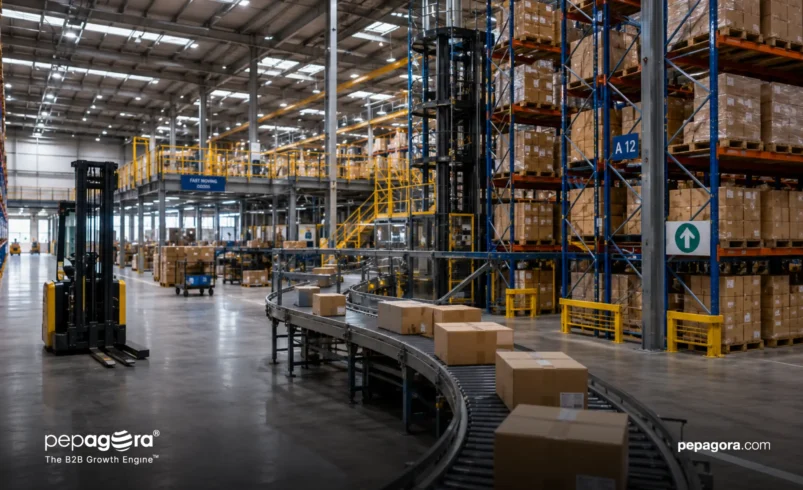

Define the operational problem and the material-flow logic before selecting the automation technology.
Warehouse automation delivers lasting value only when it begins with a clear understanding of material flow. Too often, organisations compare ASRS, robots or conveyors before defining the operational problem. A better starting point is to map inbound movement, storage profiles, replenishment, order patterns, peak loads and dispatch constraints.
This analysis clarifies whether the priority is storage density, throughput, accuracy, safety, labor resilience or a combination of these outcomes. Technology can then be selected as an integrated operating architecture rather than a collection of disconnected machines. Storage, transport, picking, controls and software must operate on a common logic and a shared data model.
Planning Area | What Leaders Should Evaluate |
Material Flow | Inbound, storage, replenishment, picking and dispatch movement |
Capacity | Current throughput, peak demand and future growth |
Technology Fit | ASRS, robotics, conveyors and controls against the operating need |
Integration | WMS, WCS and other software and data interfaces |
Lifecycle | Maintenance, spare parts, service support and scalability |
This type of evaluation helps organisations compare automation options against measurable operating requirements rather than selecting equipment in isolation. Current industry solutions increasingly combine ASRS, conveyors, robotics and software into integrated material flow architectures, making system level planning particularly important.
The design should also account for product variability, seasonality, building constraints and future expansion. This is particularly important in India, where demand patterns, channel mixes and distribution footprints can evolve quickly. Modular automation allows capacity and functionality to scale without repeatedly disrupting live operations.
Lifecycle factors belong in the concept stage: energy consumption, maintenance access, spare parts availability, service response, cybersecurity and software support. The lowest purchase price may not deliver the lowest total cost or the highest availability. Equally, the most advanced technology is not automatically the strongest operational fit.
The right solution is the one that reliably supports required business outcomes throughout its useful life. When material flow drives technology selection, automation becomes easier to operate, measure, maintain and scale. The strongest warehouse is not the most automated; it is the most appropriately automated.
A Practical Path to Better Automation Decisions
For leaders planning the next phase of warehouse development, the strongest starting point is operational clarity. Map the existing flow, establish measurable performance objectives, identify constraints and then determine where automation can create the greatest value. This approach also creates a clearer basis for evaluating suppliers and comparing different technology architectures.
Automation should be treated as an operating system for material movement rather than simply an equipment purchase. A well designed solution can bring storage, transport, controls and software together while allowing the operation to adapt as volumes, product profiles and customer expectations change. Scalable automation and modular material handling approaches can support this flexibility as warehouse requirements evolve.
Closing Perspective
The objective of warehouse automation is not to automate every movement. It is to create a reliable, measurable and scalable flow of materials that supports the business. When leaders begin with material flow and select technology around clearly defined outcomes, automation becomes a strategic capability rather than simply another capital investment.
Selected references
[1] Colliers India – Industrial & Logistics Snapshot, Q1 2026
[2] Ministry of Food Processing Industries – Integrated Cold Chain and Value Addition Infrastructure
Press Information Bureau – Three Years of India’s National Logistics Policy
Publication note. These perspectives are intended for strategic discussion. Final automation architecture requires site-specific data validation, simulation, safety and standards review, and detailed engineering.
FAQs
Material flow analysis helps identify how receiving, storage, replenishment, picking, consolidation, packing and dispatch interact. It allows organisations to identify bottlenecks and operational priorities before choosing ASRS, robotics, conveyors or other automation technologies.
Leaders should consider throughput, storage density, order profiles, peak demand, accuracy, availability, building constraints, maintenance requirements, software integration, scalability and long term service support.
No. The strongest solution is the one that fits the material flow, operating requirements, building conditions and future business needs.
The views expressed in this article are the author’s personal and professional perspectives.