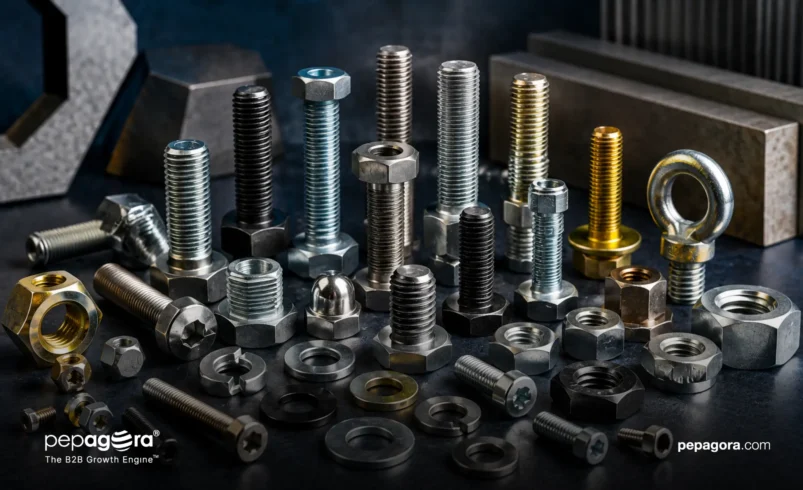

Every industrial product begins with reliable connections. Whether it is a manufacturing machine, steel structure, automotive assembly, power distribution system, or processing equipment, fasteners provide the mechanical strength that keeps components securely joined. Their role is often overlooked because of their size, yet the performance of an entire system can depend on the quality of a single bolt or nut.
Fasteners are essential components used to join and secure parts in various industries. Proper selection of fastener grade, material, and coating ensures strength, safety, and durability. Quality checks such as dimensional inspection, thread gauging, and hardness testing help maintain product reliability. Compliance with ISO, DIN, ASTM, and ASME standards ensures consistent performance and customer satisfaction. Readers who want to understand the different types of industrial fasteners can refer to this overview of industrial fasteners, nuts, and bolts.
Fastener Selection Begins with the Application
Selecting a fastener is an engineering decision rather than a purchasing decision. Every application places different demands on a fastening system. A bolt used in a heavy construction project experiences different loads and environmental conditions than one installed in food processing equipment or electrical panels.
Factors such as load capacity, operating temperature, vibration, corrosion exposure, and maintenance requirements should all be evaluated before selecting a fastener. A mismatch between the application and the fastener specification can reduce equipment life and increase maintenance costs.
Material Selection Determines Performance
The material used to manufacture a fastener has a direct impact on its mechanical properties and durability.
Carbon steel remains one of the most widely used materials because it offers an excellent balance of strength and affordability. Stainless steel is commonly selected where corrosion resistance is essential, including marine, pharmaceutical, and food processing industries. Alloy steel provides greater tensile strength for demanding applications such as mining, heavy engineering, and automotive manufacturing. Brass and aluminum are preferred in specialized applications that require corrosion resistance, electrical conductivity, or reduced weight.
Choosing the right material helps ensure that the fastener performs reliably throughout its service life.
Why Fastener Grades Matter
A fastener grade defines its mechanical strength and load carrying capability. Selecting a higher grade simply because it appears stronger is not always the correct approach. Engineering calculations determine the appropriate grade based on the expected operating conditions.
Using an incorrect grade may lead to thread damage, bolt stretching, joint loosening, or premature failure. Matching the fastener grade to the application improves both safety and long term performance.
Surface Protection Extends Service Life
Industrial environments expose fasteners to moisture, chemicals, heat, and outdoor weather conditions. Protective surface finishes help reduce corrosion and maintain structural integrity over time.
Common surface treatments include zinc plating, black oxide, phosphate coating, and hot dip galvanizing. The choice of coating depends on the operating environment rather than appearance alone. Proper surface protection reduces maintenance requirements and increases service life.
Quality Inspection Supports Reliable Performance
Consistent manufacturing quality is essential for industrial fasteners. Before products are released, manufacturers perform several inspections to verify that every fastener meets dimensional and mechanical requirements.
Quality Inspection | Purpose | Industrial Benefit |
Dimensional inspection | Confirms size and tolerances | Ensures accurate assembly |
Thread gauging | Verifies thread precision | Prevents installation problems |
Hardness testing | Confirms mechanical strength | Improves long term reliability |
Many manufacturers also perform tensile testing, proof load testing, coating thickness measurement, and metallurgical analysis for applications requiring higher levels of quality assurance.
International Standards Ensure Consistency
Industrial supply chains rely on standardized fasteners to maintain compatibility between manufacturers and equipment.
Standards such as ISO, DIN, ASTM, and ASME establish common requirements for dimensions, materials, testing methods, and mechanical performance. Compliance with these standards simplifies procurement, improves product consistency, and supports quality assurance across global industries.
Industries That Depend on Quality Fasteners
Fasteners are found in almost every industrial sector, including:
- Construction and infrastructure
- Automotive manufacturing
- Heavy engineering
- Oil and gas
- Renewable energy
- Electrical equipment
- Railway systems
- Aerospace
- Agricultural machinery
- Industrial automation
Although the applications differ, every industry depends on secure mechanical joints that can perform reliably under demanding operating conditions.
Final Thoughts
Fasteners account for only a small portion of the total cost of an industrial project, yet they have a significant impact on safety, equipment reliability, and operational efficiency. Careful attention to material selection, fastener grade, protective coatings, manufacturing quality, and compliance with international standards helps create stronger assemblies and reduces the risk of unexpected failures.
In modern engineering, reliable performance is built on precision at every level. Fasteners may be small components, but they remain one of the most important elements holding industries together.
FAQs
The most important factors include material, grade, coating, load requirements, operating environment, and compliance with relevant industry standards.
These standards define quality, dimensions, material specifications, and testing methods, helping ensure consistency, safety, and compatibility across industrial applications
Stainless steel is commonly preferred for corrosive environments because it offers excellent resistance to rust, moisture, and many chemicals, making it suitable for marine, food processing, and outdoor applications.